Details
-
Type:
Task
-
Status: Closed (View Workflow)
-
Priority:
 Major
Major
-
Resolution: Done
-
Affects Version/s: None
-
Fix Version/s: None
-
Labels:None
-
Story Points:2
-
Epic Link:
-
Sprint:Summer 1, Summer 2, Summer 3
Description
Use case:
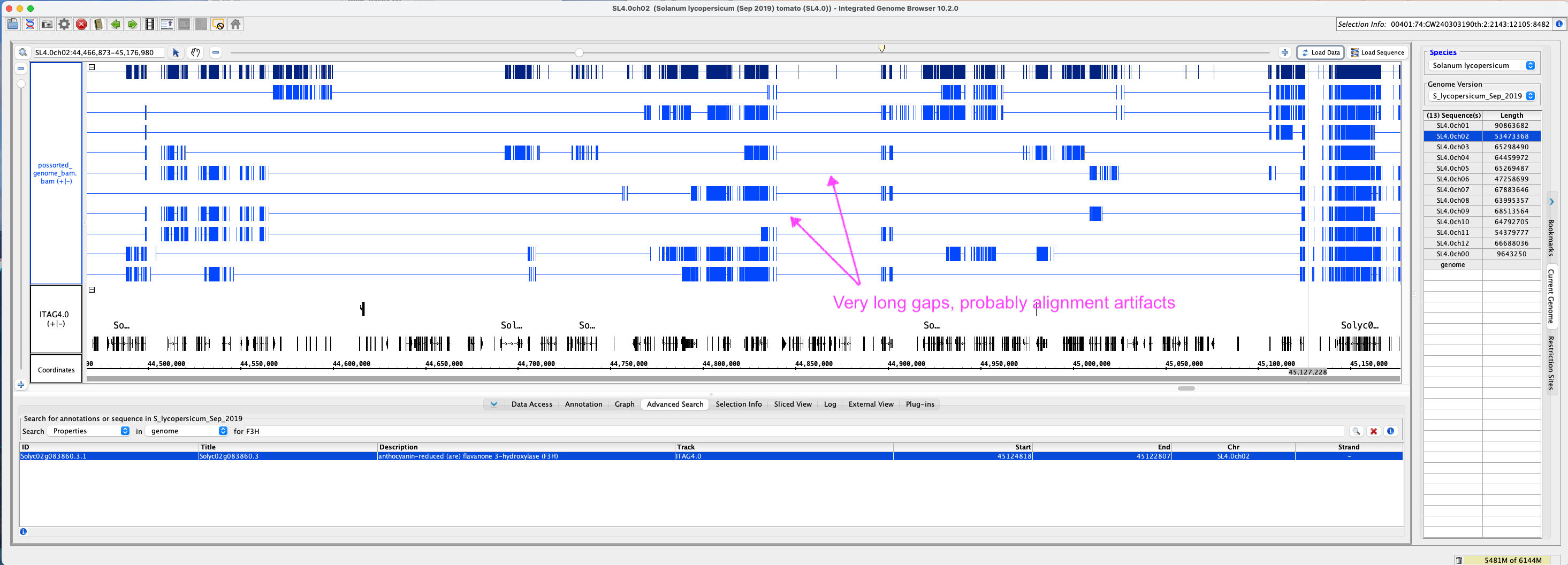
We have observed that many alignments from single cell RNA-Seq experiments look wrong. That is, the aligned sequences contain enormous gaps relative to the genomic sequence. These seemingly spurious alignments appear to support introns that are way too large and which are unlikely to be real.
It would be helpful if a user (me  ) could apply a filter that would hide such apparently spurious alignments.
I propose creating an all-new IGB App that would allow a user to hide any alignments with gaps (e.g., introns) that are longer than a user-entered value. Also, to save effort, let's choose a default length of 10,000 bases.
See attached for an image showing examples of overly long gaps in a alignments track.
See this directory for example data:
Note that the file named "possorted_genome_bam.bam" contains many alignments with extremely long gaps. Also, please note that the reference genome assembly for this data file is from the tomato Sept 2019 assembly, also called "SL4". In IGB, this genome assembly versions' name is: "S_lycopersicum_Sep_2019." It is the second most recent genome version for tomato available from our Quickload sites.
The data are from an experiment done by Rasha from Mark Johnson's lab and the data are already submitted to the Sequence Read Archive under accession SRP538407. Also, the "run_1_S1" directory correspond to sample run 1 representing unpollinated pistil maintained at 28 degrees C, the non-stressed temperature treatment, and has SRA accession SRR30982324.
A good example gene to focus on during development can be found by using the Advanced Search tab and entering "F3H"
Info about this gene:
title: Solyc02g083860.3
id: Solyc02g083860.3.1
description: anthocyanin-reduced (are) flavanone 3-hydroxylase (F3H)
start: 45,124,818
end: 45,122,807
length: 2,011
Attachments

Issue Links
- relates to
-
-
- Closed
-
Activity
| Field | Original Value | New Value |
|---|---|---|
| Epic Link | IGBF-1908 [ 17998 ] |
| Description |
Use case:
We have observed that many alignments from single cell RNA-Seq experiments look wrong. That is, the aligned sequences contain enormous gaps relative to the genomic sequence. These seemingly spurious alignments appear to support introns that are way too large and which are unlikely to be real. It would be helpful if a user (me :-) could apply a filter that would hide such apparently spurious alignments. I propose creating an all-new IGB App that would allow a user to hide any alignments with gaps (e.g., introns) that are longer than a user-entered value. Also, to save effort, let's choose a default length of 10,000 bases. See attached for an image showing examples of overly long gaps in a alignments track. |
Use case:
We have observed that many alignments from single cell RNA-Seq experiments look wrong. That is, the aligned sequences contain enormous gaps relative to the genomic sequence. These seemingly spurious alignments appear to support introns that are way too large and which are unlikely to be real. It would be helpful if a user (me :-)) could apply a filter that would hide such apparently spurious alignments. I propose creating an all-new IGB App that would allow a user to hide any alignments with gaps (e.g., introns) that are longer than a user-entered value. Also, to save effort, let's choose a default length of 10,000 bases. See attached for an image showing examples of overly long gaps in a alignments track. See this directory for example data: * http://igbquickload-main.bioviz.org/scRNASeq/RashaSingleCellRNASeq/run_1_S1/outs/ Note that the file named "possorted_genome_bam.bam" contains many alignments with extremely long gaps. The data are from an experiment done by Rasha from Mark Johnson's lab and the data are already submitted to the Sequence Read Archive under accession SRP538407. Also, the "run_1_S1" directory correspond to sample run 1 representing unpollinated pistil maintained at 28 degrees C, the non-stressed temperature treatment, and has SRA accession SRR30982324. |
| Description |
Use case:
We have observed that many alignments from single cell RNA-Seq experiments look wrong. That is, the aligned sequences contain enormous gaps relative to the genomic sequence. These seemingly spurious alignments appear to support introns that are way too large and which are unlikely to be real. It would be helpful if a user (me :-)) could apply a filter that would hide such apparently spurious alignments. I propose creating an all-new IGB App that would allow a user to hide any alignments with gaps (e.g., introns) that are longer than a user-entered value. Also, to save effort, let's choose a default length of 10,000 bases. See attached for an image showing examples of overly long gaps in a alignments track. See this directory for example data: * http://igbquickload-main.bioviz.org/scRNASeq/RashaSingleCellRNASeq/run_1_S1/outs/ Note that the file named "possorted_genome_bam.bam" contains many alignments with extremely long gaps. The data are from an experiment done by Rasha from Mark Johnson's lab and the data are already submitted to the Sequence Read Archive under accession SRP538407. Also, the "run_1_S1" directory correspond to sample run 1 representing unpollinated pistil maintained at 28 degrees C, the non-stressed temperature treatment, and has SRA accession SRR30982324. |
Use case:
We have observed that many alignments from single cell RNA-Seq experiments look wrong. That is, the aligned sequences contain enormous gaps relative to the genomic sequence. These seemingly spurious alignments appear to support introns that are way too large and which are unlikely to be real. It would be helpful if a user (me :-)) could apply a filter that would hide such apparently spurious alignments. I propose creating an all-new IGB App that would allow a user to hide any alignments with gaps (e.g., introns) that are longer than a user-entered value. Also, to save effort, let's choose a default length of 10,000 bases. See attached for an image showing examples of overly long gaps in a alignments track. See this directory for example data: * http://igbquickload-main.bioviz.org/scRNASeq/RashaSingleCellRNASeq/run_1_S1/outs/ Note that the file named "possorted_genome_bam.bam" contains many alignments with extremely long gaps. Also, please note that the reference genome assembly for this data file is from the tomato Sept 2019 assembly, also called "SL4". In IGB, this genome assembly versions' name is: "S_lycopersicum_Sep_2019." It is the second most recent genome version for tomato available from our Quickload sites. The data are from an experiment done by Rasha from Mark Johnson's lab and the data are already submitted to the Sequence Read Archive under accession SRP538407. Also, the "run_1_S1" directory correspond to sample run 1 representing unpollinated pistil maintained at 28 degrees C, the non-stressed temperature treatment, and has SRA accession SRR30982324. A good example gene to focus on during development can be found by using the Advanced Search tab and entering "F3H" |
| Description |
Use case:
We have observed that many alignments from single cell RNA-Seq experiments look wrong. That is, the aligned sequences contain enormous gaps relative to the genomic sequence. These seemingly spurious alignments appear to support introns that are way too large and which are unlikely to be real. It would be helpful if a user (me :-)) could apply a filter that would hide such apparently spurious alignments. I propose creating an all-new IGB App that would allow a user to hide any alignments with gaps (e.g., introns) that are longer than a user-entered value. Also, to save effort, let's choose a default length of 10,000 bases. See attached for an image showing examples of overly long gaps in a alignments track. See this directory for example data: * http://igbquickload-main.bioviz.org/scRNASeq/RashaSingleCellRNASeq/run_1_S1/outs/ Note that the file named "possorted_genome_bam.bam" contains many alignments with extremely long gaps. Also, please note that the reference genome assembly for this data file is from the tomato Sept 2019 assembly, also called "SL4". In IGB, this genome assembly versions' name is: "S_lycopersicum_Sep_2019." It is the second most recent genome version for tomato available from our Quickload sites. The data are from an experiment done by Rasha from Mark Johnson's lab and the data are already submitted to the Sequence Read Archive under accession SRP538407. Also, the "run_1_S1" directory correspond to sample run 1 representing unpollinated pistil maintained at 28 degrees C, the non-stressed temperature treatment, and has SRA accession SRR30982324. A good example gene to focus on during development can be found by using the Advanced Search tab and entering "F3H" |
Use case:
We have observed that many alignments from single cell RNA-Seq experiments look wrong. That is, the aligned sequences contain enormous gaps relative to the genomic sequence. These seemingly spurious alignments appear to support introns that are way too large and which are unlikely to be real. It would be helpful if a user (me :-)) could apply a filter that would hide such apparently spurious alignments. I propose creating an all-new IGB App that would allow a user to hide any alignments with gaps (e.g., introns) that are longer than a user-entered value. Also, to save effort, let's choose a default length of 10,000 bases. See attached for an image showing examples of overly long gaps in a alignments track. See this directory for example data: * http://igbquickload-main.bioviz.org/scRNASeq/RashaSingleCellRNASeq/run_1_S1/outs/ Note that the file named "possorted_genome_bam.bam" contains many alignments with extremely long gaps. Also, please note that the reference genome assembly for this data file is from the tomato Sept 2019 assembly, also called "SL4". In IGB, this genome assembly versions' name is: "S_lycopersicum_Sep_2019." It is the second most recent genome version for tomato available from our Quickload sites. The data are from an experiment done by Rasha from Mark Johnson's lab and the data are already submitted to the Sequence Read Archive under accession SRP538407. Also, the "run_1_S1" directory correspond to sample run 1 representing unpollinated pistil maintained at 28 degrees C, the non-stressed temperature treatment, and has SRA accession SRR30982324. A good example gene to focus on during development can be found by using the Advanced Search tab and entering "F3H" Info about this gene: {quote} title: Solyc02g083860.3 id: Solyc02g083860.3.1 description: anthocyanin-reduced (are) flavanone 3-hydroxylase (F3H) start: 45,124,818 end: 45,122,807 length: 2,011 {quote} |
| Attachment | ARE-SL4-BigRegion-BigGaps-1-annotated.png [ 18704 ] |
Other tips:
- Check into whether you can use the "CIGAR" string (e.g., 33S26M443557N91M) to eliminate alignments with too-long gaps
- In this case, we think that the "3557N" syntax is indicating the size of a large gap covering 3,557 genomic sequence bases
- Also, check out the filters "Reads with Gaps" and "Reads with no Gaps" for ideas on how to implement this new filter
Ideas for the filter name:
Show only:
- Reads without monster gaps
| Assignee | saideepthi jagarapu [ sjagarap ] |
| Link | This issue relates to IGBF-4214 [ IGBF-4214 ] |
| Status | To-Do [ 10305 ] | In Progress [ 3 ] |
Connecting IGB app filter with igb needs some brainstorming and time. As this feature is on urgent requirement proceeding to not create seperate app for this filter.
After discussion with Dr Freese, We planned to not create a new app for hiding large gaps functionality, instead create filter functionality in igb codebase itself.
Testing guide:
- User enters a value and selects a comparator (like >,<=,>=,=) , check if the gaps with selected conditions are hidden or not.
- How to figure out gapsize ? Use "CIGAR" string (e.g., 33S26M443557N91M) 443557N syntax is indicating the size of a large gap covering 443557 genomic sequence bases.
Branch changes: https://bitbucket.org/lorainelab-deepthi/integrated-genome-browser/branch/IGBF-4235
| Status | In Progress [ 3 ] | Needs 1st Level Review [ 10005 ] |
| Assignee | saideepthi jagarapu [ sjagarap ] |
| Assignee | saideepthi jagarapu [ sjagarap ] |
Changes after IGB app integration
App changes - https://bitbucket.org/lorainelab-deepthi/reads-without-large-gaps/commits/branch/main
| Assignee | saideepthi jagarapu [ sjagarap ] |
| Sprint | Summer 1 [ 218 ] | Summer 1, Summer 2 [ 218, 219 ] |
| Rank | Ranked higher |
saideepthi jagarapu: Can your app be installed in the released version of IGB, without the changes to the IGB codebase?
Change requests:
- You need to fix your repository so that it can build the App and the repository.xml file and then copy the artifacts to the Downloads section. The only way I can test the App is if you build it and make it available for installation.
- Please make sure that your App can be installed and run in IGB 10.1.0, the released version of IGB.
- Fix your repository so that the IGB issues are made into links back to the corresponding Jira issue. See the on-boarding tickets for how to do that.
Once these are done, return the ticket to "Needs first level review" for testing.
| Status | Needs 1st Level Review [ 10005 ] | First Level Review in Progress [ 10301 ] |
| Status | First Level Review in Progress [ 10301 ] | To-Do [ 10305 ] |
| Assignee | saideepthi jagarapu [ sjagarap ] |
IGB codebase changes are not required, I'm able to install app without running IGB locally. I should populate my jar and repository.xml file in downloads while running pipeline.
| Status | To-Do [ 10305 ] | In Progress [ 3 ] |
Question:
- Can the App run in IGB 10.1.0 ?
Yes Dr Loraine
Suggestion:
- Check repository variables for https://bitbucket.org/lorainelab-deepthi/reads-without-large-gaps/.
- Try: BITBUCKET_USERNAME Deepthi2001
- And: BITBUCKET_REPO_OWNER lorainelab-deepthi
suggestion:
check this line: MathComparisonOperator comp = comparator.get();
Update:
- I forked saideepthi jagarapu's repository and was able to run the pipeline after defining these three repository variables: BITBUCKET_USERNAME, BITBUCKET_REPO_OWNER, BITBUCKET_APP_PASSWORD
- How I defined the above variables:
BITBUCKET_USERNAME aloraine
BITBUCKET_REPO_OWNER aloraine
BITBUCKET_APP_PASSWORD [ private ]
- Note that "aloraine" is what is shown in the URL address for my repository. The "trick" to getting this pipeline to run in your repository is defining these variables correctly, probably.
- My fork address: https://bitbucket.org/aloraine/reads-without-large-gaps
attn: saideepthi jagarapu
Update:
- As mentioned in the preceding comment, I was able to get my fork of saideepthi jagarapu's repository to build the App jar file and the repository.xml configuration file and then copy the artifacts to my fork's Download's section
- I then launched IGB 10.1.0, the released version of IGB.
- I added the Downloads section to my launched IGB 10.1.0 as a new "App repository" and then installed the filter App from this custom-added App repository
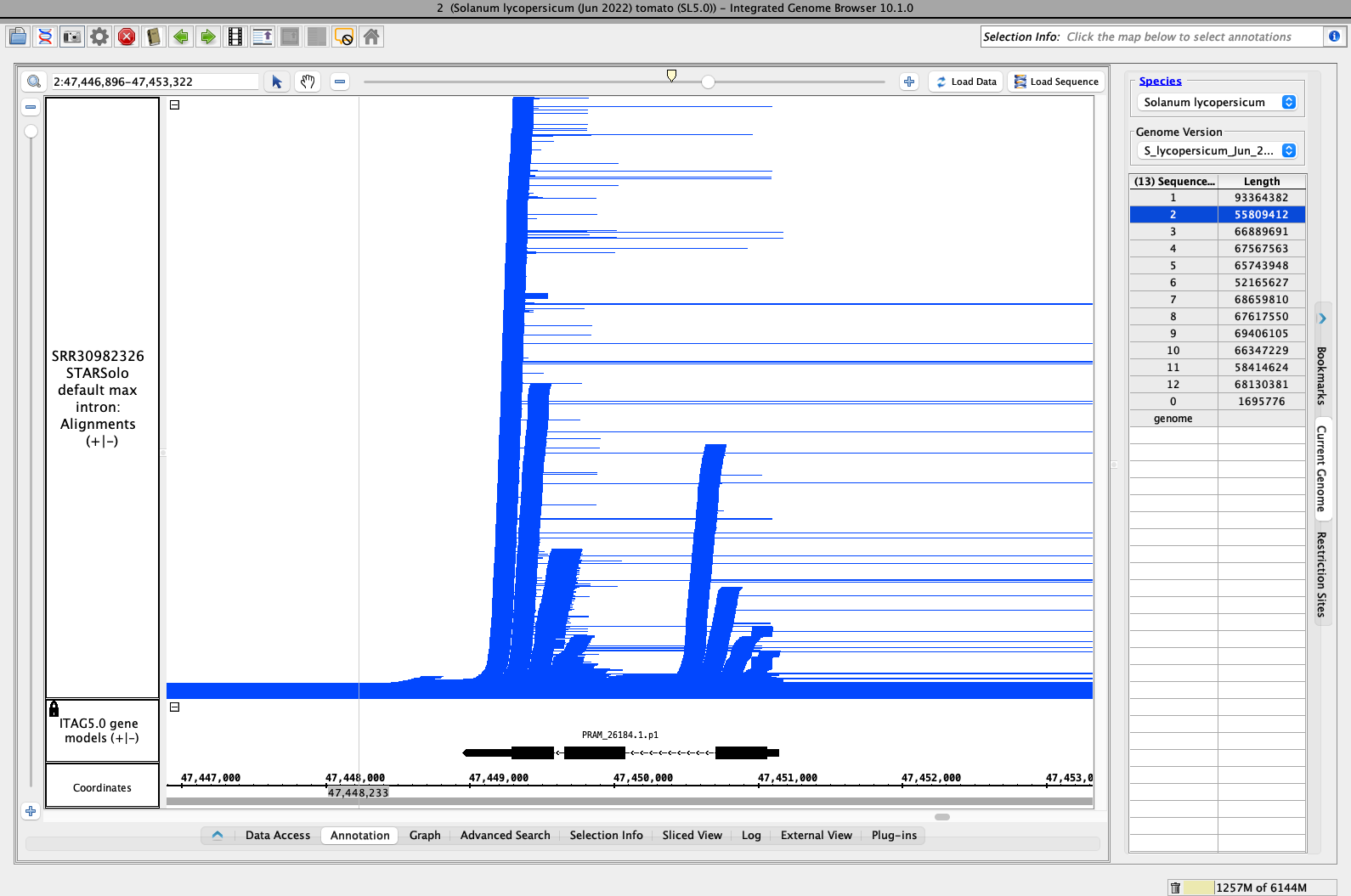
- I then loaded some data from a Galaxy History where I had run RNA STARsolo on the same single cell RNA-Seq data set twice: once with the default maximum intron parameter and once with maximum intron size parameter set to a more reasonable value. This "run" (History) is available from the Public Histories tab in the EU UseGalaxy.eu server. The name of the history (currently) is Pistil single-cell RNA-Seq - One sample (SRR30982326)
- But you can find it by searching public histories for my name "Loraine".
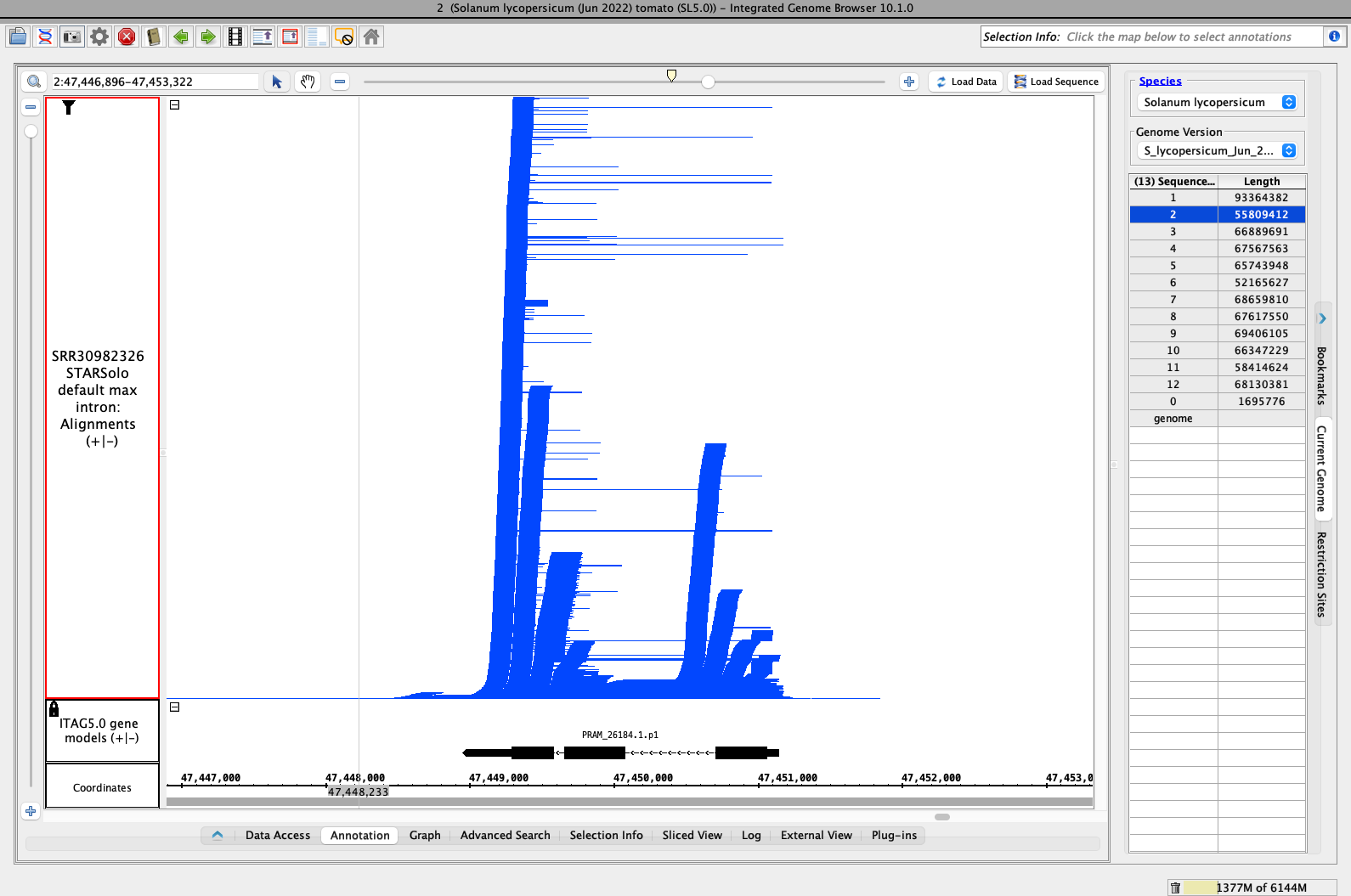
- I think loaded the default parameter data set's alignments file into IGB and tested the filter. The filter appears to be working as expected.
Your code is working as expected saideepthi jagarapu! And no changes are needed to Integrated Genome Browser.
Next up we need:
- A cool logo for your new App
- A cool name for your new App
- Documentation suitable for appearing in the App Manager interface when users select the App
- The App Store also needs to show basically the same README as used for the App
- Finally, releasing the App in the App Store
- Creating a team App repository for the Loraine Lab space (Ann will fork Deepthi's repository within the Loraine Lab workspace.)
could continue using her fork as the "main" repo and submit PR's to main branch from there to the lorainelab space repo.
Attached images show the App doing it's thing. We can deploy these images on the App Store, maybe, to show the App in action.
| Attachment | SL5-ARE-SRR30982326-max-intron-default-all-reads.png [ 18705 ] | |
| Attachment | SL5-ARE-SRR30982326-max-intron-default-all-reads-post-filter-monster-gaps.png [ 18706 ] |
Sure [~ann.loraine], I'll come up with logo and name ideas and work on documentation related to app. Also, investigate the failure of jar file generation.
[~ann.loraine]
Some of the app name suggestions:
Large Gap Read Trimmer
Oversized Gap Trimmer
Spurious Alignment Filter
Alignment Gap Remover
Hi saideepthi jagarapu! Here are my thoughts on the names:
I think a name that includes the words "Alignment Filter" is good. The filter only works on alignment tracks, and it is a filter. So it seems like a good, evocative name.
I know it maybe sounds a little weird, but I can't get past thinking of it as a "Monster alignment filter!"
About the other names:
To me, the words "trimmer" and "remover" imply that something will get removed and maybe not given back. But this is not what exactly what IGB track filters do. They hide things from view, and users can make them visible again by removing the filter.
| Attachment | Screenshot 2025-06-18 at 7.41.14 AM.png [ 18713 ] |
| Attachment | app description.png [ 18714 ] |

| Attachment | Screenshot 2025-06-18 at 7.41.14 AM.png [ 18713 ] |
[~ann.loraine] I have added app description to this app. Please review
Branch: https://bitbucket.org/lorainelab-deepthi/reads-without-large-gaps/branch/IGBF-4235
Changes made: https://bitbucket.org/lorainelab-deepthi/reads-without-large-gaps/pull-requests/1
Update:
- After saideepthi jagarapu merged her PR into her repo's main branch, I cloned my own fork to my local and added her repo as the "upstream" repo
- I then pulled the new main branch commit from her repo into my clone's main branch and then pushed to main on my repo.
- The "push" triggered the default pipeline on my fork
- The new artifacts (,jar file and .xml file) are deployed to my fork - see: https://bitbucket.org/aloraine/reads-without-large-gaps/downloads/
Update:
- After the new artifacts are deployed, I used updated jar file to submit the app for bioviz.org
- [~ann.loraine] Please review and approve the app.
Request for saideepthi jagarapu:
- Unfortunately there was a problem with the App Store and I had to delete your app.
- Please re-submit your new app!
I have resubmitted again [~ann.loraine] Can you please review
I reviewed and now the App is in the App Store. Please check it.
Also, a new request for saideepthi jagarapu:
- Please add more steps between 3 and 4:
3. Open a BAM alignment track.
4. Use the input field to set a maximum gap size (default: 10,000 bases).
Tell the user how to get to the "input field" step. Search the user's guide for terminology. I think it needs to say something like "Right-click on the BAM track label" then "Choose Fiilter" then choose the filter, and then 4.
Atten saideepthi jagarapu:
- I edited the App description using the App Store interface.
- Please grab the new text and update the source code App Description using the new text.
Main changes:
I removed the text about adding a new tabbed panel. (The app does not do this.)
Also, I made some edits to the description to make it (hopefully!) easier to understand.
| Sprint | Summer 1, Summer 2 [ 218, 219 ] | Summer 1, Summer 2, Summer 3 [ 218, 219, 220 ] |
| Rank | Ranked higher |
[~ann.loraine] I have updated the app description as mentioned,
branch changes: https://bitbucket.org/lorainelab-deepthi/reads-without-large-gaps/commits/08c7680d8db28c9e84f1246822b80ee1233e733b
Please take a pull to loraine space.
| Status | In Progress [ 3 ] | Needs 1st Level Review [ 10005 ] |
Thank you saideepthi jagarapu. Please merge your branch into the main branch in your repository. I will then update my fork's main branch.
| Status | Needs 1st Level Review [ 10005 ] | First Level Review in Progress [ 10301 ] |
| Status | First Level Review in Progress [ 10301 ] | Ready for Pull Request [ 10304 ] |
I have already merged my branch to main, please take pull to your space. [~ann.loraine]
| Status | Ready for Pull Request [ 10304 ] | Pull Request Submitted [ 10101 ] |
| Status | Pull Request Submitted [ 10101 ] | Reviewing Pull Request [ 10303 ] |
| Status | Reviewing Pull Request [ 10303 ] | Merged Needs Testing [ 10002 ] |
| Status | Merged Needs Testing [ 10002 ] | Post-merge Testing In Progress [ 10003 ] |
| Resolution | Done [ 10000 ] | |
| Status | Post-merge Testing In Progress [ 10003 ] | Closed [ 6 ] |
Tips on how to work with these alignments data: